Imagined Selves, Systems, Societies

Last year, around this time, I did an Ode to the Road and my déraciné lifestyle. This post is a different kind of wandering, one I hope to do even when my bones and joints are incapable of the first: the imagination.
In a writing class, the poet Jacob Ross tried to attune us to the “pleasures of the text,” asking us to read with an eye for why we’re enjoying something. He told me that all too often I was hurtling through my story plots, rather than letting people savor as they read. It made me realize that I mistakenly believed “pacing” was about how fast the plot moved, rather than how fast the reader turned the page. What keeps the reader hooked is not “stuff happening, lots of stuff, oh hey, here’s more stuff,” but rather what that stuff means and how it makes them feel. So I’ve been turning what was originally a trilogy into what it deserves to be – a series of potentially more than seven books, offering more “pleasures of the text,” including many I personally want to experience while writing them.
So what are such pleasures? Language, of course, is its own joy, and rooting myself in so many languages while exploring more possibilities in the fantasy world I’m creating gives me a unique sense of adventure. The intersection of language and history creates infinite worlds to inhabit. For instance, in ancient India, young girls were fed poisons until they built up immunity and then used as assassins in statecraft. These poison maidens (another reference) now become part of the fantasy world I get to explore.
But I’ll focus on three particular joys today that are also skills I’m honing in my craft:
Imagined Selves and the pursuit of greater Empathy
Nearly every writer gets to experience this through their characters, but I’ve particularly been working on sinking deeper and deeper into multiple points of view. I want my author-self to become all but invisible, and if you’re reading a chapter from X’s point of view, it’s so completely immersive that you become X for that little while. That endless capacity for becoming is empathy: the ability to dissolve preconceived notions about the world and other people and walk, for a little while, in someone else’s skin.
Algorithms of Betrayal is the first of my novels that uses two POV characters who couldn’t be more different than each other. It is also the first novel where the main character is a man, rather than a woman. I’ve written before about how liberating that was, and why sinking into the self of my latest character is proving more difficult. I usually have to wait a day before hopping heads, which means writing out of order, and trying to remember what happened in the last scene with this character. But it’s paying off, with characters now talking to me much more readily, speaking as themselves rather than saying what they need to say to move the plot forward. It’s delightful.
Imagined Systems and the pursuit of greater Balance
While most fiction involves stories between people, many of these stories operate within a particular system. Academia stories involve a school system, as does most YA. There may be class systems, racial systems, and of course the ever-present patriarchy. The system may be in space, or a magic system with hierarchies and organization of power. Systems fascinate me, in work and in life, because systems thinking is how we find sustainable long-term solutions to complex problems. The UK government even provides civil servants with a systems thinking toolkit and case studies, although given the state of the economy I’m not entirely sure how much they’re using these things.
When the system is rigged in a particular way, Step 1 is understanding it. Most YA novels involve the protagonist realizing that the system is rigged against them, then making allies and blowing things up. Xiran Jay Zhao’s Iron Widow follows this pattern, but the sequel, Heavenly Tyrant is where things get interesting – sure, capitalist exploitation is bad, so you blew up the bad leaders, but now that you’re in charge, can you actually get your agenda through? It’s hilarious.
The systems in my stories usually involve layers. We have many flavors of gendered oppression, from Saudi religious police to well-intentioned tech executives, layered in with the ways class, race and religion tend to pit women against each other when they could work together instead. While I’ve occasionally used “quit the system” or “game the system for your own ends” as a happy ending for my characters, I really want to find a way to change the system in a way that I believe is both plausible and sustainable. That’s what keeps me motivated to write through to the end of this 7+ book series. These characters can’t find happiness outside the system, so they must change it for everyone.
(So mayyyybe this is about convincing myself not to retire from tech).
Imagined Societies and the pursuit of greater Peace
An anime I recently got hooked on is Spy x Family, which is set in Cold War Germany, featuring a spy from “Westalis” who must have a normal family to avoid scrutiny by the Secret Police of “Ostania” while he works to bring about peace between the two nations. Although set in the past, it’s eerily timely, given the state of the world. The conflicts between nations are rarely simple or set within a single generational moment, and certainly never settled by a single battle (or any number of them). Having studied political philosophy for a while in college, I’m always fascinated by fiction that actually portrays the conflicts well, even if the stories don’t solve them.
In the Apothecary Diaries, which does a great job, we see the conflicts of today having their roots in generations past. A long-dead empress wished to improve the literacy of the nation. To reduce the cost of paper, slave labor was used and timber forests were razed. Now there’s a plague of locusts, and the famine that’s coming is almost always a precursor to war. What I’m consistently impressed by in the novel series is the deep knowledge of supply chain issues. Most political novels rely on sharp intellectual dialogue between leaders with different views to convey conflict. But in the Apothecary Diaries, a man eats his lunch on a napkin, and Maomao realizes he’s from a wealthy family who can afford to use paper that way.
When I moved into my apartment, the internet conked out after a storm and remained broken for a month. Turns out a poorly-made building (once you opt out of high European standards) can’t survive London weather for even five years. The storm caused a leak in the basement, taking out the network routers. Since those were custom-made and purchased for cheap from Taiwan, local replacements would not work. Getting replacements took weeks, because shipping vessels were going around Africa to avoid the Houthi pirates in the Red Sea. When they finally arrived, it took a few more weeks to find builders (because of Brexit). Fact is sometimes stranger than fiction, but this only goes to show that the precursors to war are often visible as supply chain issues. I’m working on being able to “show, not tell” such conflict.
And hopefully solve it?
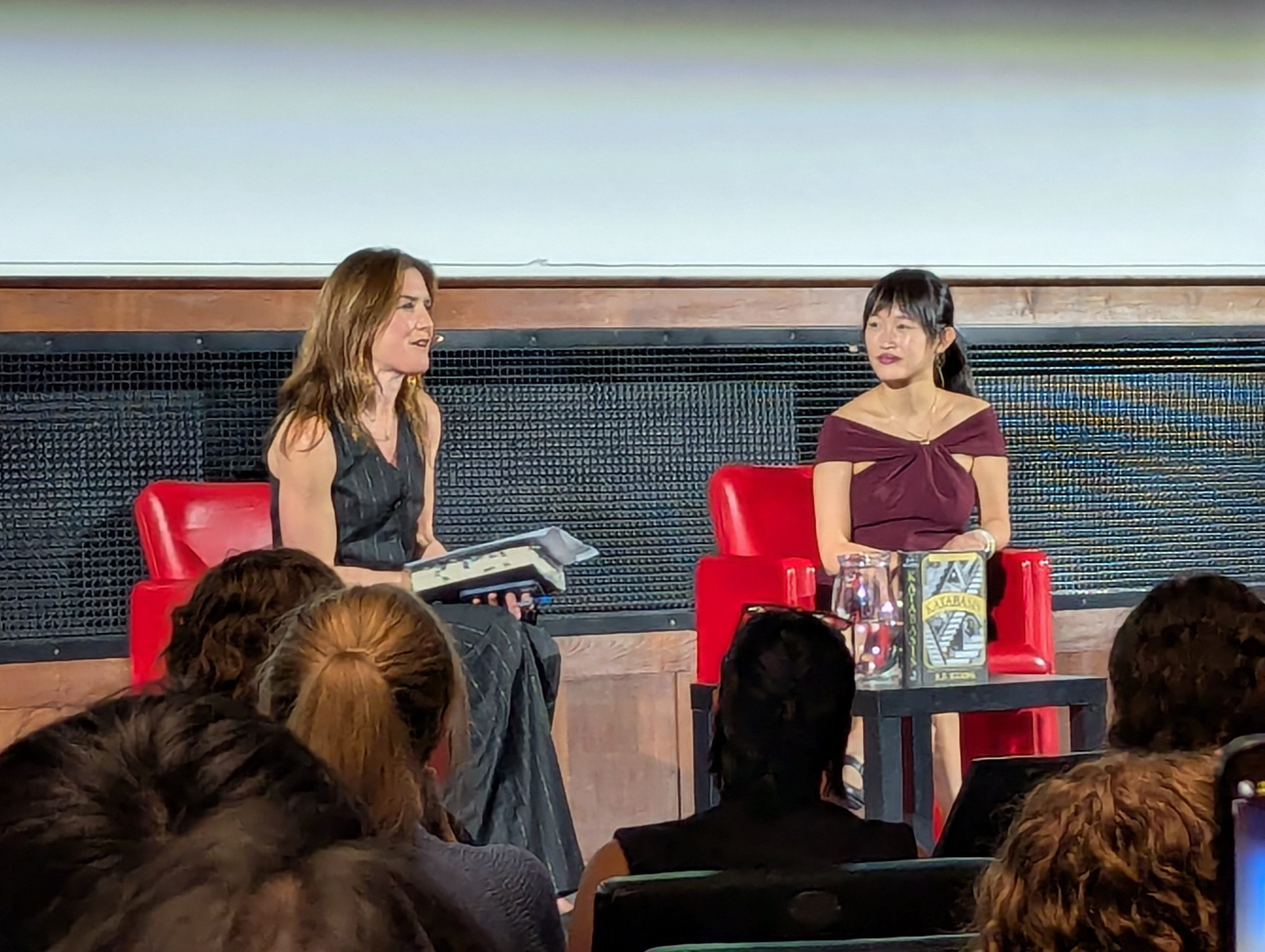
Last week, I got to see author R. F. Kuang in person, who talked about the current rise of populism as “the burning ambition to create an invulnerable empire” rooted in deep shame and powerlessness. How can we, as writers, address that in our stories? Kuang pointed out, “Fascists don’t care about philosophical inconsistencies.” Arguments, no matter how logical, don’t work. We need something that reaches people at the deepest levels of their psyche – and that’s stories.
So why do I write like I’m running out of time? Because we are.