Writing the Ensemble

I grew up on Buffy the Vampire Slayer, and before that on Bionic Six. If you’ve never heard of the latter, I recommend watching this video about an animated cartoon from 1987 that normalized a diverse, multi-ethnic family where the Dad cooked dinner every night, the Mom was a career scientist, and Japanese animators raised the bar on the emotional depth children were expected to understand, inadvertently teaching the world a lesson on kodawari, the pursuit of excellence in craft.
Of the endless shows and stories I’ve seen or read, the ones that stick with me are those where my perspective is expanded beyond a single protagonist, where my empathy must extend not just to the “hero” of the piece but to the unique new organism formed out of individuals in relationship with each other. In an ensemble story like Bionic Six, there aren’t six protagonists, but at least seven, with the N+1’th protagonist being the whole that is sometimes stronger (and sometimes weaker) than the sum of its parts.
We miss the point when we talk about protagonists and antagonists in an ensemble story – rather, the actual protagonists are the relationships between any two individuals in the story. As a simple example, let’s take a story that has a “buddy comedy” type setup. If we were following the traditional Western Hero’s Journey, one of the buddies is the Hero, and the other is the Sidekick. So, when you add in a third character, they fit into a hub and spoke model that still centers the Hero.
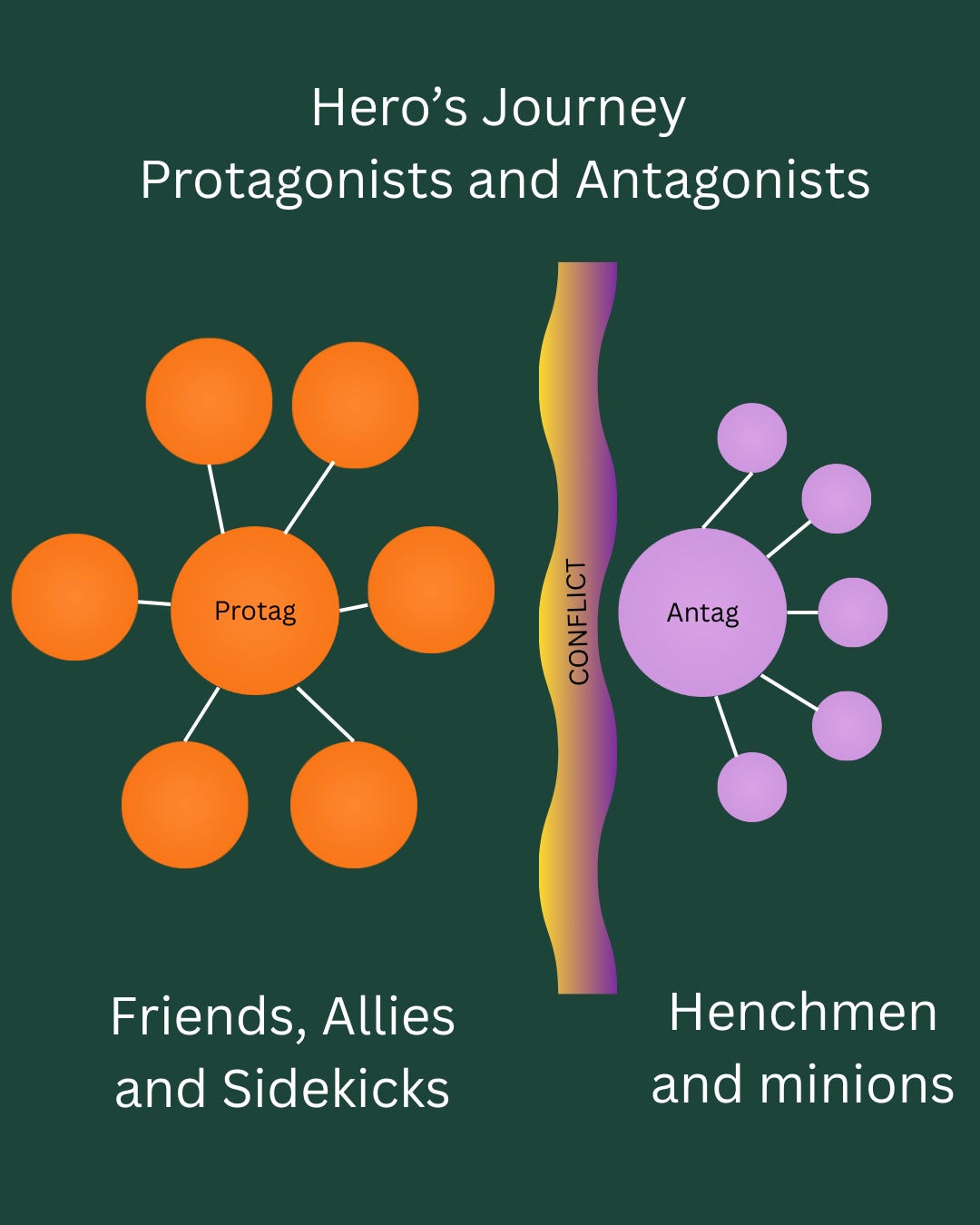
Every writing teacher will tell you to spend a lot of time thinking through your antagonist’s character and motivations (I tend not to write villains, so I prefer antagonist). Even if you don’t give your antagonist a point of view, or reveal their backstory in the text, they need to have dimension and substance, otherwise your protagonist won’t either. There’s nothing impressive about someone overcoming an antagonist who’s one-dimensional, weak, or stupid.
But in this setup, the Hero’s Journey, the primary tension is between the protagonist and the antagonist, between a Harry Potter and a Voldemort. Even if there are tensions between the protagonist’s allies, they’re usually the B-plot, romantic/sexual tension or jealousy, rarely ever the central storyline. In a pinch, when there’s a fight against the antagonist’s troops, the Scooby gang gets together, putting aside all their petty problems to fight on the same side (even if they originally sent the Hero in to fight alone).
It took Buffy the Vampire Slayer five seasons to admit they were an ensemble, and that being an ensemble is what made the TV series work and the movie fail. In an ensemble, tensions and relationships of ambivalence exist between multiple people, each of whom has significant screen time, or (if in writing) a point of view.
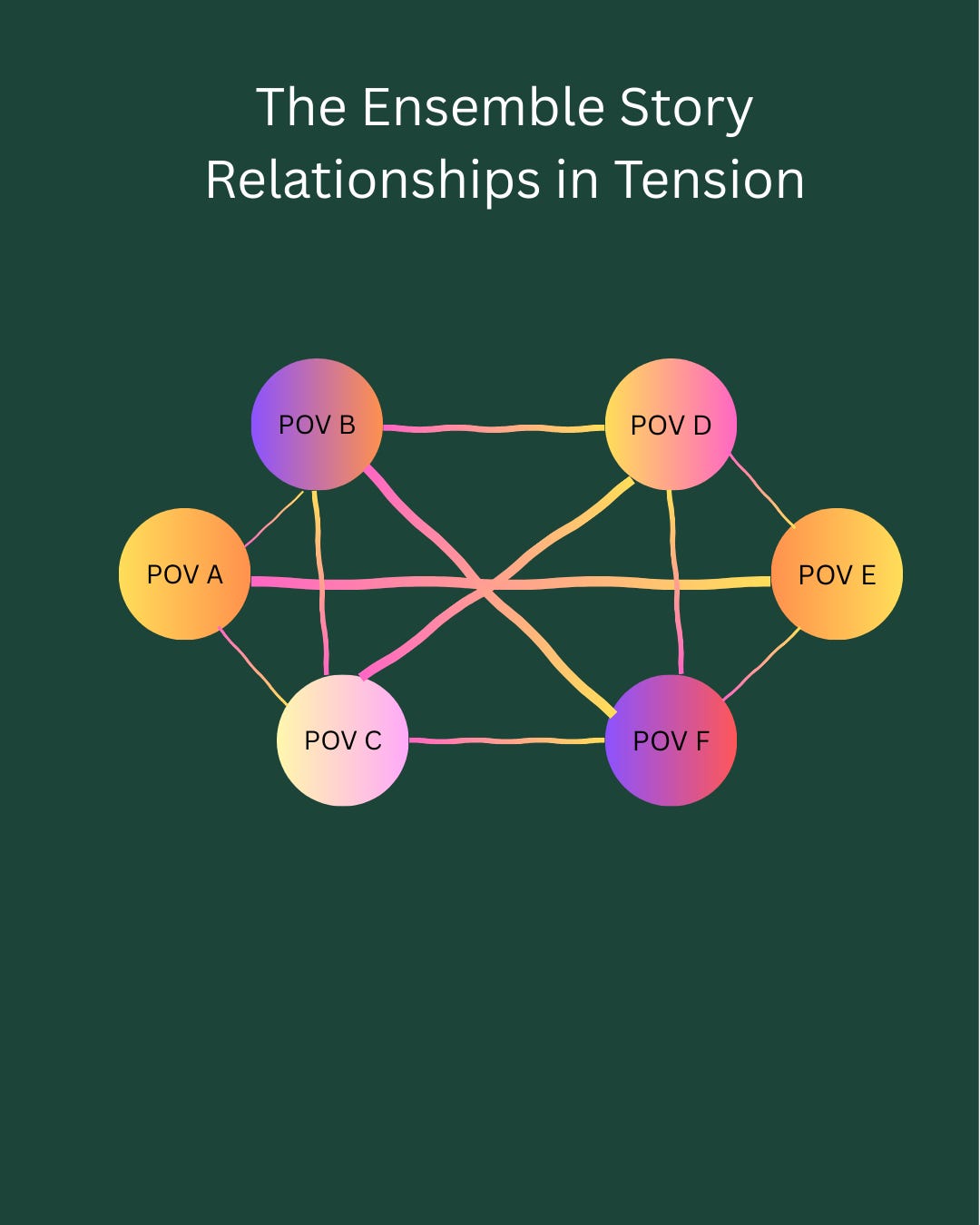
It would take Buffy another season to realize that when you have an ensemble, the great dividing line of conflict between a “hero” and a “villain” in the first image falls apart. Conflict is continuous, and it’s blurry. You never know when it will spark, and between whom, which spark will light the blaze, and whether people might switch sides at any moment. (Not giving out spoilers for Season 6, but IYKYK).
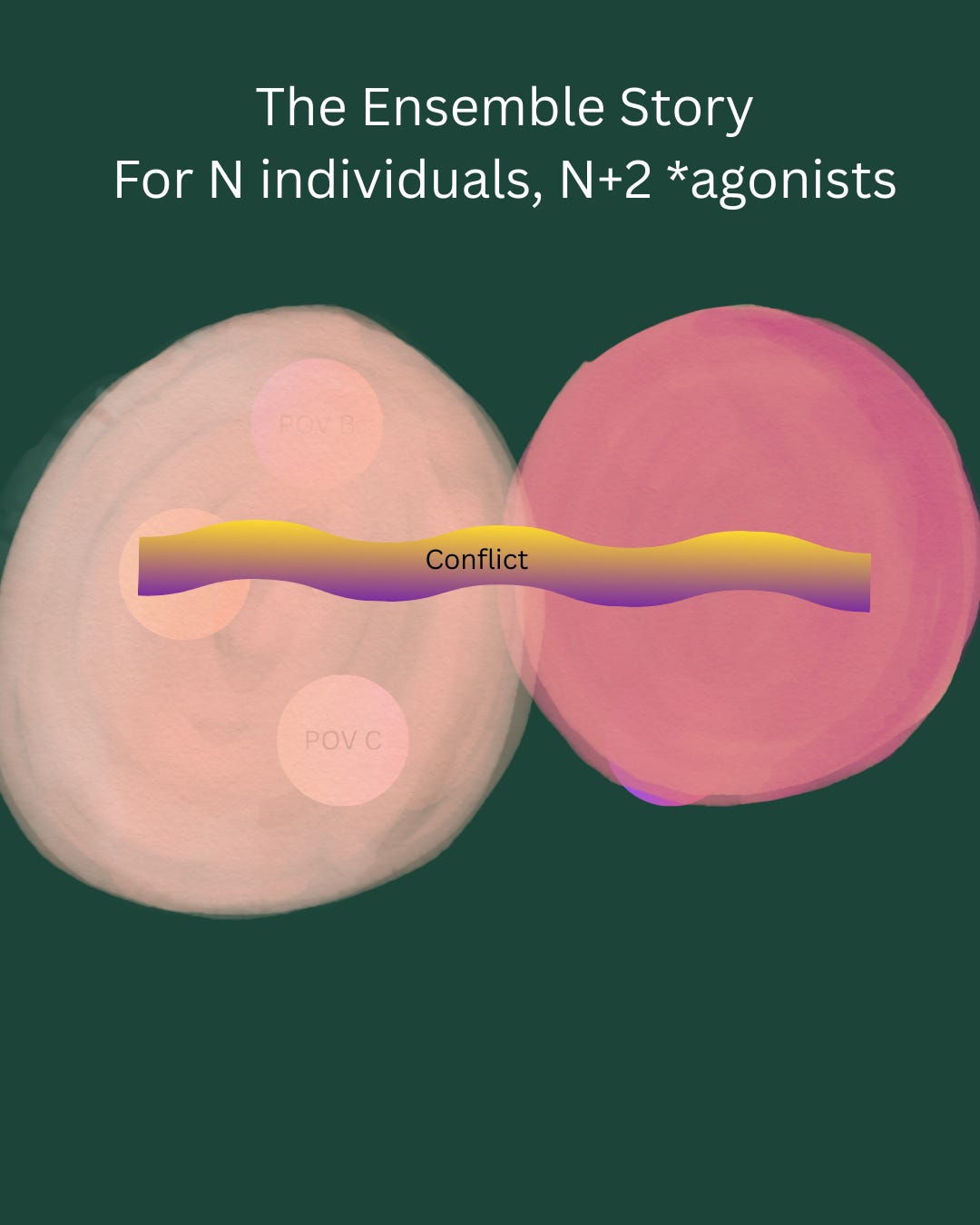
If Bionic Six taught me about the power of ensemble stories, Buffy the Vampire Slayer taught me the importance of decentering a single protagonist. But even these stories ultimately miss the mark, reinforcing Us vs. Them scenarios that reflect the corporate tycoons and nationalist tyrants who run our societies. What does it take to go from Us vs. Them to Us vs. The Problem?
That inspiration I’ve been getting elsewhere. Take, for example, this opening chapter of The Grandmaster of Demonic Cultivation by MXTX. It begins with a denunciation of the protagonist by unnamed speakers, where the world is introduced first, before you get to know anyone in it. The first thing you learn about the protagonist is that Wei Wuxian was killed by his little brother, and that “everyone” thinks this was a good thing, putting the greater good above even such a family relationship, and certainly above any individual’s life.
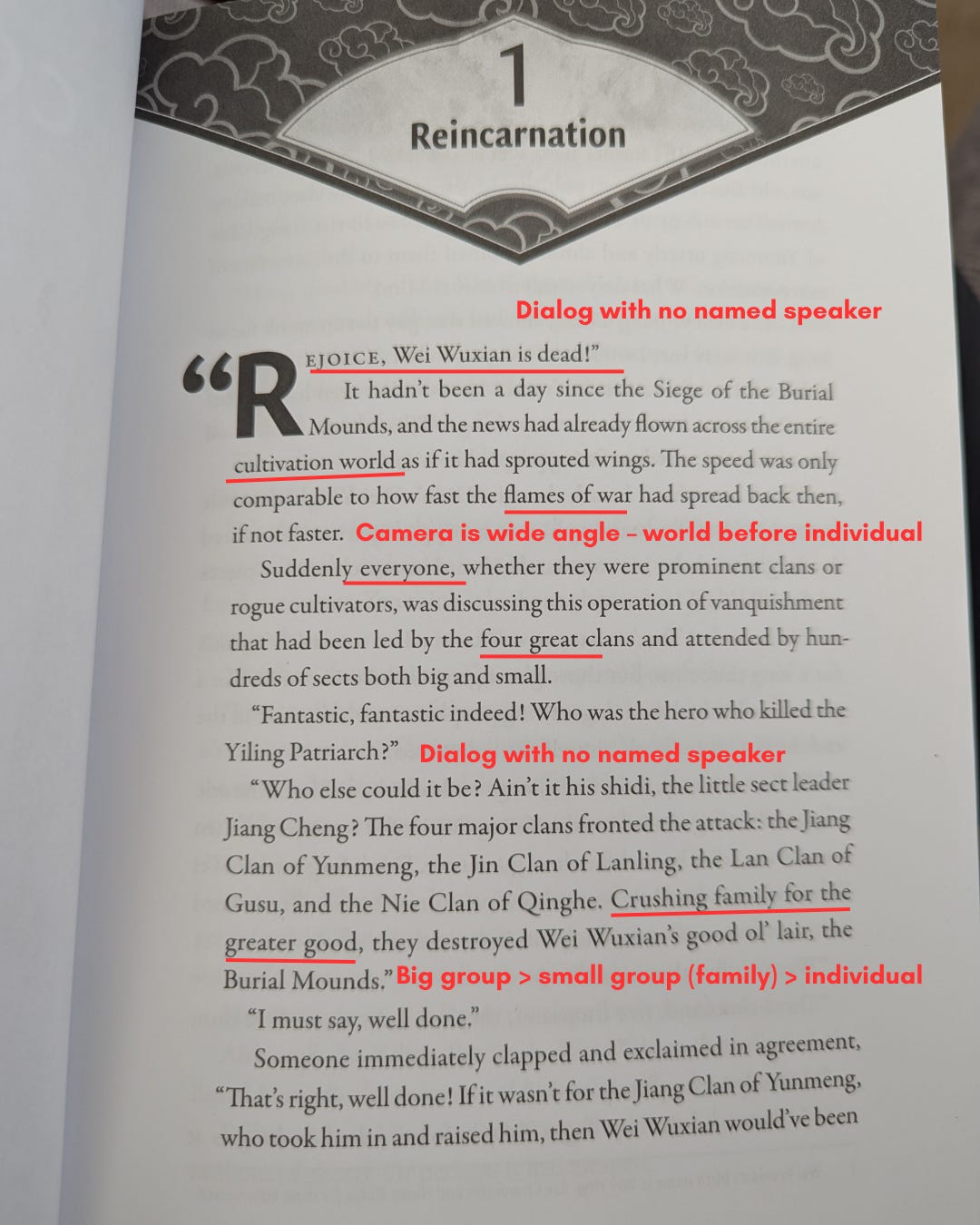
This technique is called the Rashomon effect, and if you want to learn more, I highly recommend this Substack post by Ana Sun. A quote:
For me, a perpetual student of the written word, there’s a lesson here: the telling of the same story would change if told by a different narrator to a different listener. As a writer, this is a choice I can consciously, continuously make.
Yesterday, I attended Ana’s workshop in London on Writing A Community, Not a Lone Hero. We went from “reading community” to “writing community in community.” Ana had each table pick a time and place where our story would be set, and each of us at the table pick a role we had in that world. Our table of 4 was a bazaar by the seaside, set in the far, far future when the sun is dying and all we eat is kelp.
We then each picked out roles for ourselves, which could be anything from merchants to prophets, gods or demons. After talking to each other for a while about how we each inhabit the world in relation to each other, we did a writing exercise: speaking as the role you’ve chosen, describe your community to an outsider.
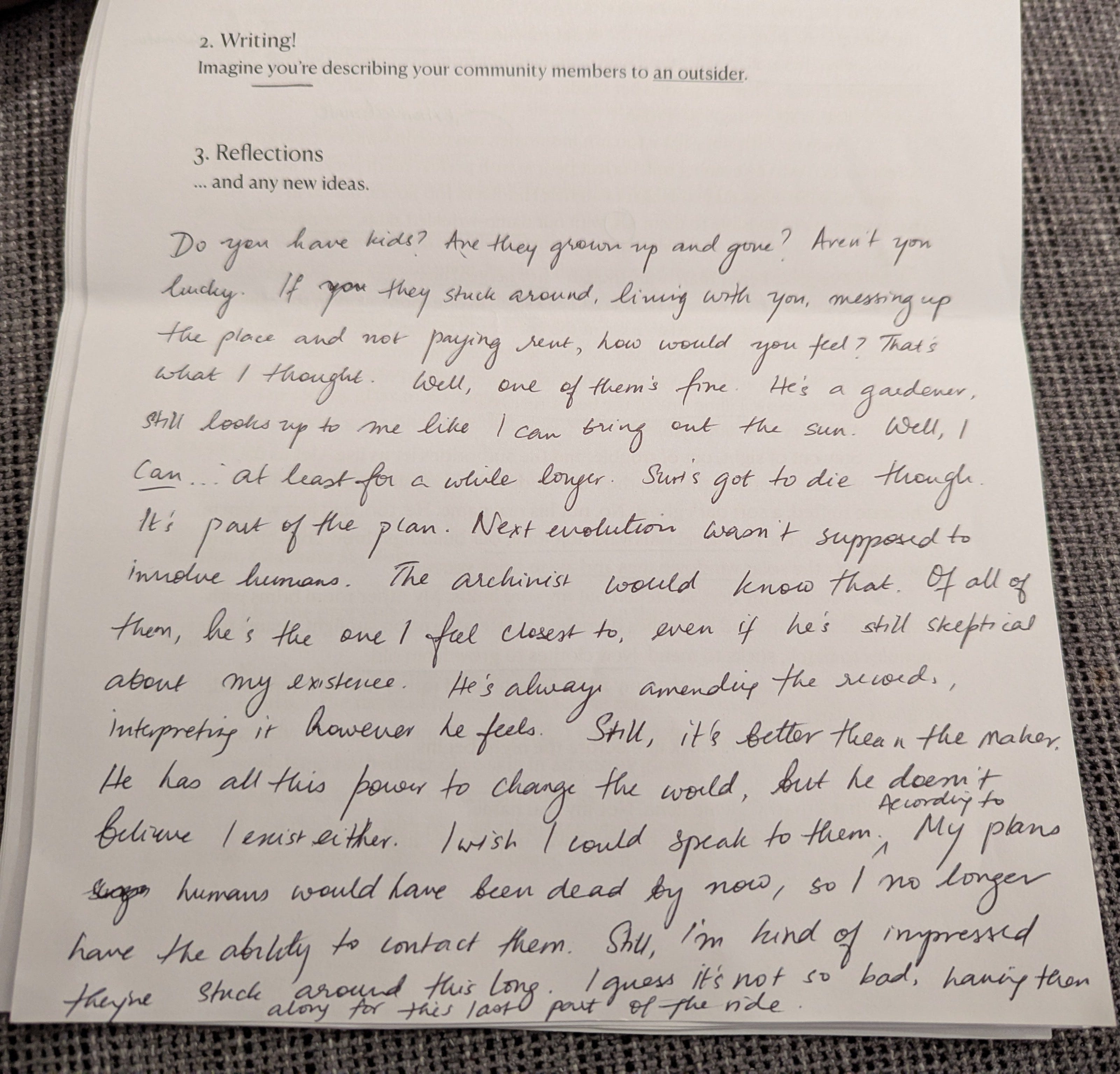
I picked the role of god (no surprise). Over the next 10 minutes, I wrote this:
Do you have kids? Are they grown up and gone? Aren’t you lucky. If they stuck around, living with you, messing up the place and not paying rent, how would you feel? That’s what I thought. Well, one of them’s fine. He’s a gardener, still looks up to me like I can bring out the sun. Well, I can… at least for a while longer. Sun’s got to die though. It’s part of the plan. Next evolution wasn’t supposed to involve humans. The archivist would know that. Of all of them, he’s the one I feel closest to, even if he’s still skeptical about my existence. He’s always amending the record, interpreting it however he feels. Still, it’s better than the maker. He has all this power to change the world, but he doesn’t believe I exist either. I wish I could speak to them. According to my plans, humans would have been dead by now, so I no longer have the ability to contact them. Still, I’m kind of impressed they’ve stuck around this long. I guess it’s not so bad, having them along for this last part of the ride.
I picked the role of “god” because if anyone was going to be the protagonist of a story, it’s a god. But even as a god, my character can’t be understood in isolation, but only in relation to others (some believe people don’t even exist except in relation to others).
At work, one of my bosses told me, “Everyone talks about wanting psychological safety, but nobody talks about creating psychological safety.” As we watch societies, economies and nations crumble, it’s more important than ever that we resist the zero-sum nature of the Hero’s Journey and learn how to write the ensemble, creating and imagining the communities that will sustain us with art and joy. (Plug here for Julia and The Joy Squad — for any writers who want a little help getting more on the page).
As for me, what gives me joy is writing, and hearing from you, otherwise I’m just a lonely god writing until the sun dies.
Um hi, life has been such that I just got around to reading this and I was riveted by all the wisdom in it (yes to not writing villains! yes to the tension of relationships driving storylines!!) and then you mentioned me?! This was really nice!! Thank you 💜
Thought-provoking, as always :)