Why Bother?

Why do we bother with any of it? Why work? Why write? Why get out of bed on a cold winter morning? What’s it all in aid of?
Over the years, I’ve gone through many periods of questioning those very things. Nobody sees it, because I can phone in my B+ game and… honestly, a B+ is more than enough most of the time. Here’s what my B+ game looks like:
Sleeping in until 10 AM or even 11 AM, missing most of the Math classes in college, and showing up only to the exams. (Ithaca was too cold for early mornings)
Taking a 3-month sabbatical from work in 2008 while the market crashed and my boss was too busy worrying about their underwater house to notice my absence.
Staying just in shape enough to enjoy my surfing vacations, but not pushing myself to actually get properly fit and advance my surfing skills.
Moving away from headquarters for some peace and quiet and good labor laws, despite the potential slowdown of promotions.
Throwing stuff in a pan with salt and chili powder and calling it dinner, instead of following the real recipe. But hey, at least I’m cooking.
There are times I bring my A game. When it’s a project I feel deeply and personally about, for instance. Or the two weeks of intense focus when I wrote The Divine Comedy of the Tech Sisterhood, which is probably still my best work. Or when I have a weekend to experiment with recreating that dish I had once a year ago and am feeling particularly adventurous.
But I don’t bring my A game to every day and every moment. It would be too exhausting. What I’ve learned though is that other people seem to think they need to do this.
Two things coincided over the last week. Several of my friends quit their jobs to be funemployed or retired. And Femcel wrote this incredible article on Capitalist Glamourism, and the brainwashing of early 2000s rom-coms about the glamor of being a writer or working in media. Some quotes:
I had this barely conscious delusion that I would work as a journalist, which would entail writing big, muckraking pieces every week, going out constantly to conduct exciting interviews, using my opportunity to be out of the office to have a bagel and black coffee with a cigarette for dessert. Then I’d rush back to the office, and a thirty-second montage would enable me to finish writing the next big, front page article before dashing off to put on some mascara in the back of a taxi before meeting my girl-and-gay friends.
Capitalist Glamourism shows you the work, then the romance, then the work, then the romance. The work, then the glamorous outfit, the work, then the glamorous outfit. These movies hypnotize you into thinking that working tastes like romance, that having a 9-5 means having a perfect outfit and a perfect strut.
Everything that she says about the media job is also true about the tech job. The parties, the money, the jetsetting lifestyle. In some ways, it’s not even a lie. After all, Her Golden Coast is based on real events. Here’s a peek into Tech-Capitalist Glamour, to which I am certainly not immune:

I had to hunt for a shot of me by myself, because most of the photos are, in fact, of me and my girl-and-gay friends. For twenty years, I’ve lived the promise that Sex and the City made to aspiring writers but failed to keep.
In the accounts of those who left work, there is a common thread: they gave more of themselves to their jobs than they ever intended, and regretted not leaving enough time for their other pursuits – writing, learning, family, health, etc. This one is particularly powerful. Some quotes below:
Applied to careers, enmeshment is what happens when your professional identity colonizes everything else
The environments most of us build careers inside are designed to produce enmeshment, the way a greenhouse is designed to produce a certain kind of growth. The more time, energy, and mental space the job demands, the less room remains for any other version of you to develop.
In some ways, that was what I realized was happening to me in 2008, when I took that sabbatical. I needed to learn the contours of my soul so I could defend it from the demands of my job . I bummed around Europe, and then went to Oxford. I stayed in Phillip Pullman’s old room at Exeter, climbed out onto the roof at night, and took this magical photo:

I’d already studied at Oxford once before, but it was on this 3-week trip that I really became a Writer. Every morning, I woke up at 8 AM (AAAARGH!) ate a sparse, tasteless breakfast, and then sat down to write. For hours. All we did was write, critique, read, repeat. We built the endurance and discipline needed to complete a novel, until there would no longer be a question of whether the Muse would visit us that day. If I sit down to write, I’ll write.
A skill which became all the more important once I returned to work. The #1 question people ask me is: How do you manage to write while you have a full-time job? That question really could be asked of anybody. How do you write if you have kids? How do you write if you have roommates?
But these are all the wrong questions. The right one is: WHY do you write?
The answer can’t be: Because I want to strut around NYC in Manolo Blahniks. In that case, you probably need a tech job. It also can’t be: Because I want to be a published author. That usually means your idea of what it means to be “A Published Author” involves more Capitalist Glamourism. The reality of being a published author is staring sadly at Goodreads to avoid staring sadly at the draft of your next novel.
If you don’t have an answer as to why you write and what you want to do with your life, you won’t be able to withstand the constant onslaught that is a full-time job, or kids, or life admin. Or the endless rejections, radio silence, and the doubt that dogs your steps when you decide on the writing life. This is true for whatever is your soul’s passion – holding onto it is hard work.
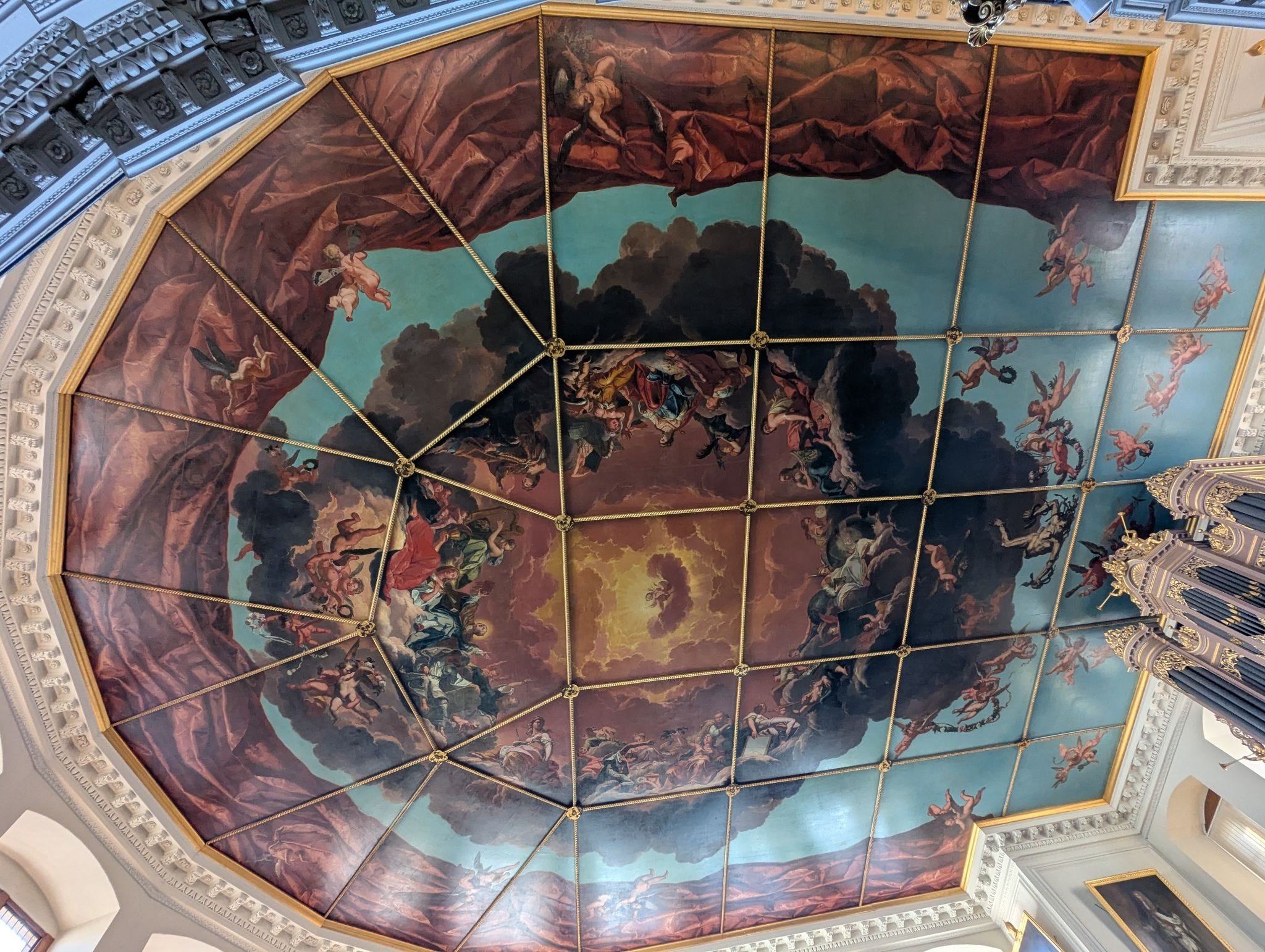
Last weekend, I returned to Oxford for a seminar on The Good, The Beautiful, and The True. A friend introduced me to Iain McGilchrist, who is a fantastic speaker who writes books so heavy they require a suitcase to carry. He spoke about Value – what it is, and how easy it is to lose sight of what makes life worth living. It was rather lovely to listen to all this in the Sheldonian Theatre, whose architecture I studied while at Oxford:
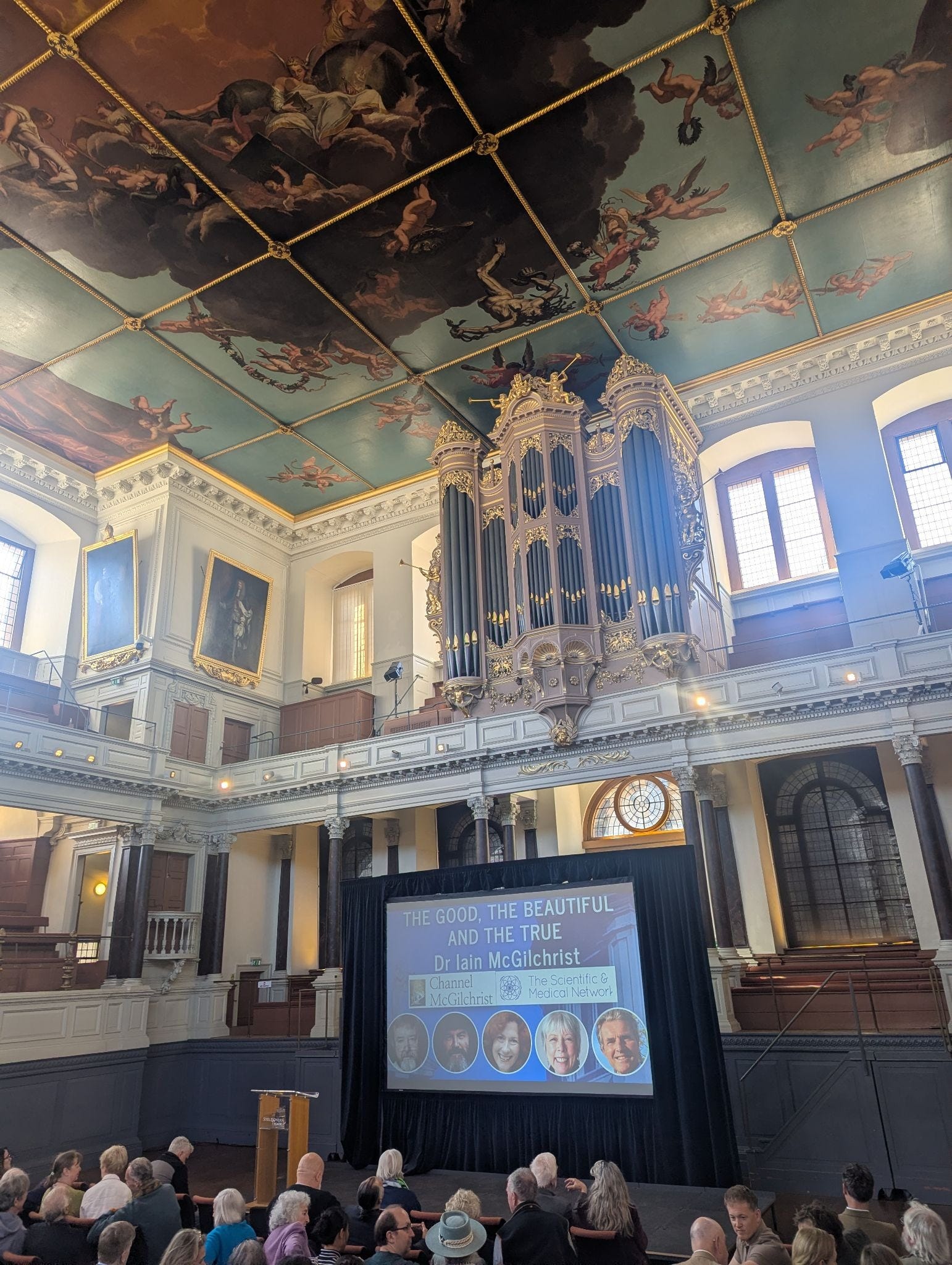
I also like this photo that shows McGilchrist in front of a slide with a quote from Eugene Wigner: “Where in the Schrodinger equation do you put the joy of being alive?”
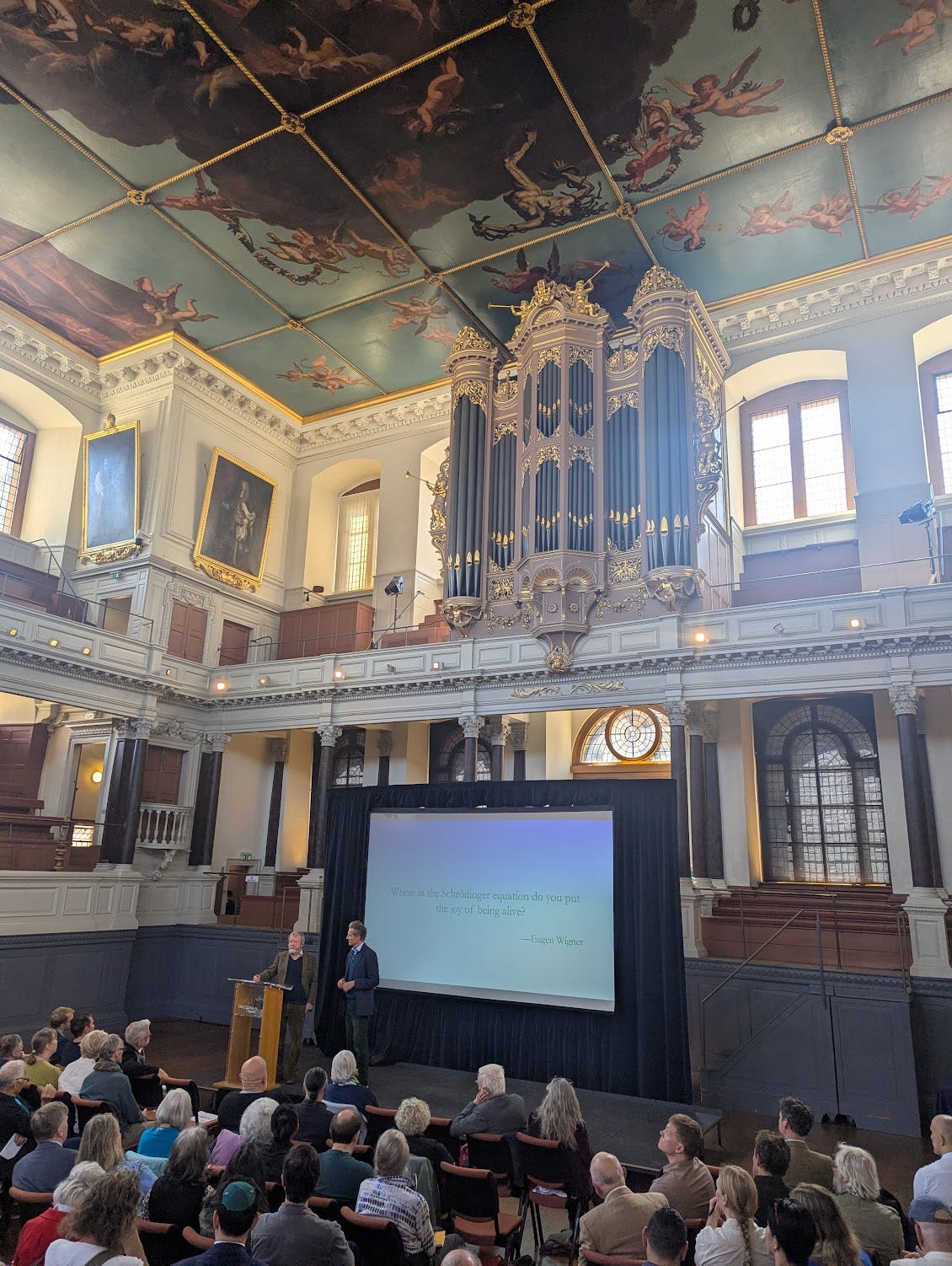
To me, writing is simply that – an expression of the joy of being alive. Yes, that joy is sometimes extremely hard won, but that’s what makes it worth doing. The rest of it – the fancy tech-job, the status and title, the jetsetting lifestyle – they enable my writing life, but would absolutely be abandoned the minute they got in the way of it. (Ruthless prioritization, people). The job is the means, not the end. Technology is a means, not the end. I refuse to let them colonize my mind or encroach upon my free time.
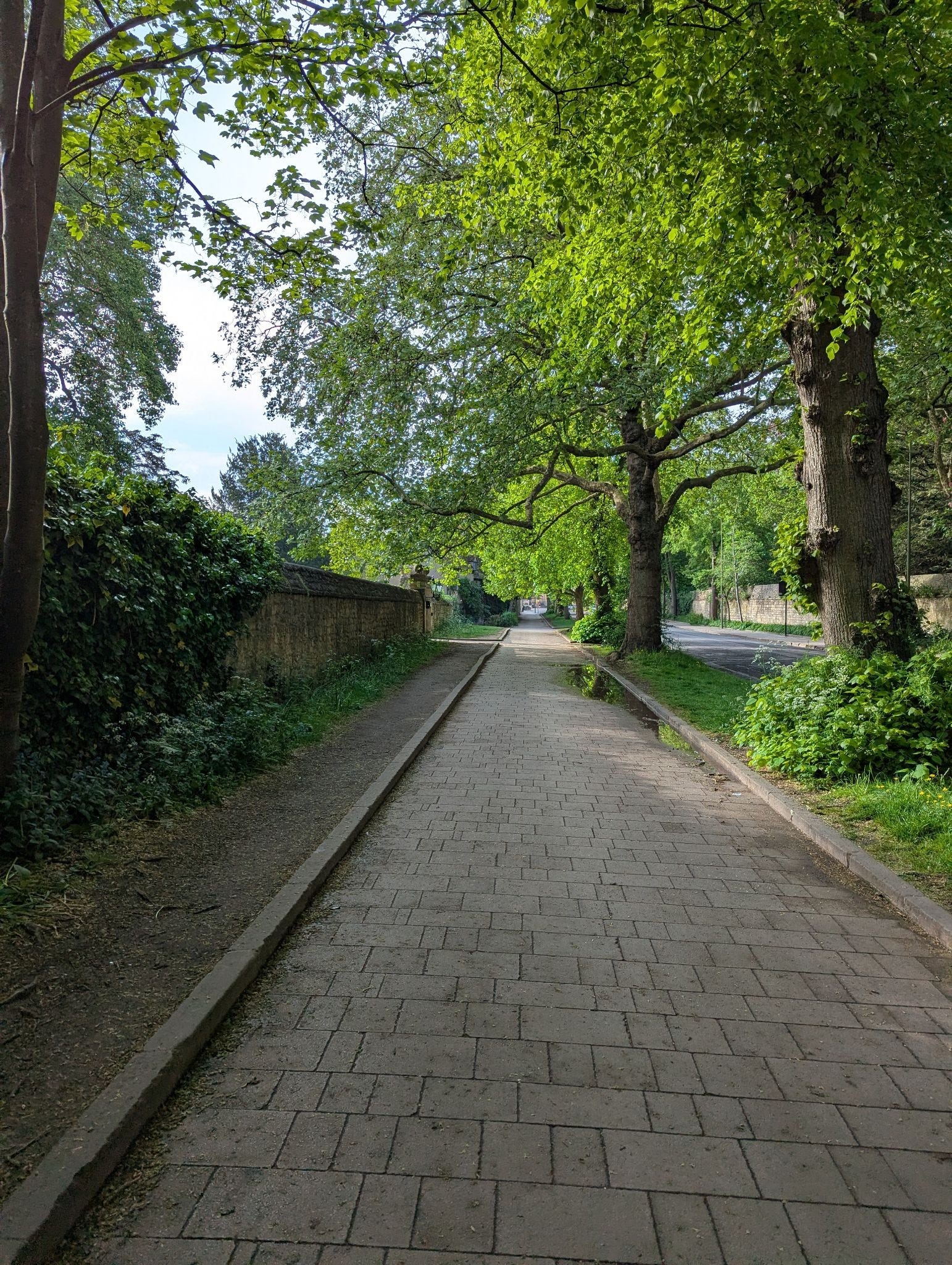
On Sunday morning, I walked this path in Oxford on my way to the Sheldonian theatre. I had to stop and take this picture which fails to capture the rain-fresh luminosity or the scent of morning, or the thrill of being alone in an otherwise busy landscape. It was just me and the trees. Such a tragedy that this path, a “means” by definition, isn’t treated more as an end in itself. This, not Math class, is worth getting out of bed at way-too-early in the morning. This, not work, is worth my A game, and the full presence of my soul.
Oh well, the Sheldonian theatre isn’t so bad either.
I sometimes worry that if I stop to ask why, it may derail my effort. It's like not knowing how good you really are at something. You just... do it. There is value in self-examination, especially if your whole life requires it. For me, the greatest joy doesn't come from "Why do you write?" but from "What did you write?" I have always had a creative itch to scratch (music, drawing, landing killer jokes while public speaking for work). The only time I am set back is when I ask "What did you write?" and I don't have an answer. (Insert creative art here) is joy.
I feel all fo that! And I've been loving the funemployed life. I'm still working, but only when and on what I want to.