The Acrylic Novel
Or, how to get a first draft done

Today, I finished the first draft of my latest standalone novel, one that was brutal to write. I started it in April 2025, putting the time at about 9 months. For context, I can usually jam out a first draft in about 3 months or less. I thought I’d share both why my first drafts are usually fast, and why this one was so difficult.
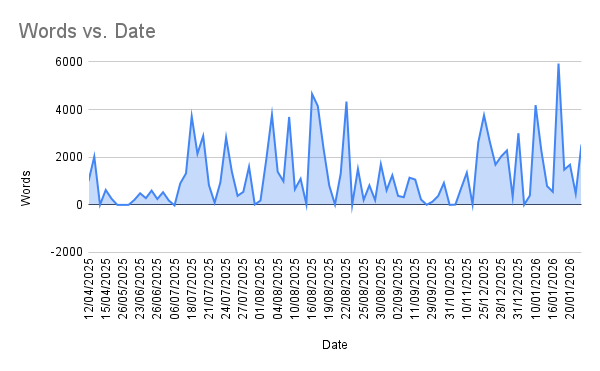
But first, some context about timelines and first drafts.
My first novel, Driving by Starlight, took roughly one month in 2011 for a first draft, but only got to publication in 2018, seven years later. While Driving by Starlight was in submissions to publishers, my agent advised me to get started on the next book. Given the timelines involved, I would need to have many projects ready in case this one didn’t work out. Many projects die on submission, so it was important to have a portfolio approach.
Reader, I failed. I simply couldn’t start Book 2 while I was on tenterhooks about Book 1. I couldn’t context-switch between editing and marketing Book 1 to the creative mindset I needed for Book 2. I collected story ideas, scenes, snippets of conversations that could grow into a novel, but I couldn’t focus long enough to write Book 2. To quote this excellent essay, I was too busy with the business of writing to do any real writing.
For seven years.
And when I finally got started on Book 2, I got stuck in the middle. Every author I know falls into this quagmire at one point or another, where they’re halfway through the first draft and they start to doubt themselves. There comes the critical choice: close your eyes, hold your breath and run to the end, or turn back in doubt, like Orpheus, and watch your dreams crumble.
Make no mistake – there’s only one choice here that actually gets you a novel.
I’ve learned several tricks over the years to make that first draft easier to actually finish, which almost all come down to mindset: letting go of perfectionism, and holding true to a vision.
The first draft is acrylic, not woodcut.
Have you ever tried painting with acrylic? It’s glorious. I’m both clumsy and not artistically inclined, but I love playing with colorful goop. Especially if there’s wine involved. Acrylic is extremely forgiving. You painted green into the sky? Whoops! No problem. Wait five minutes, drink some wine and paint over it. All gone.
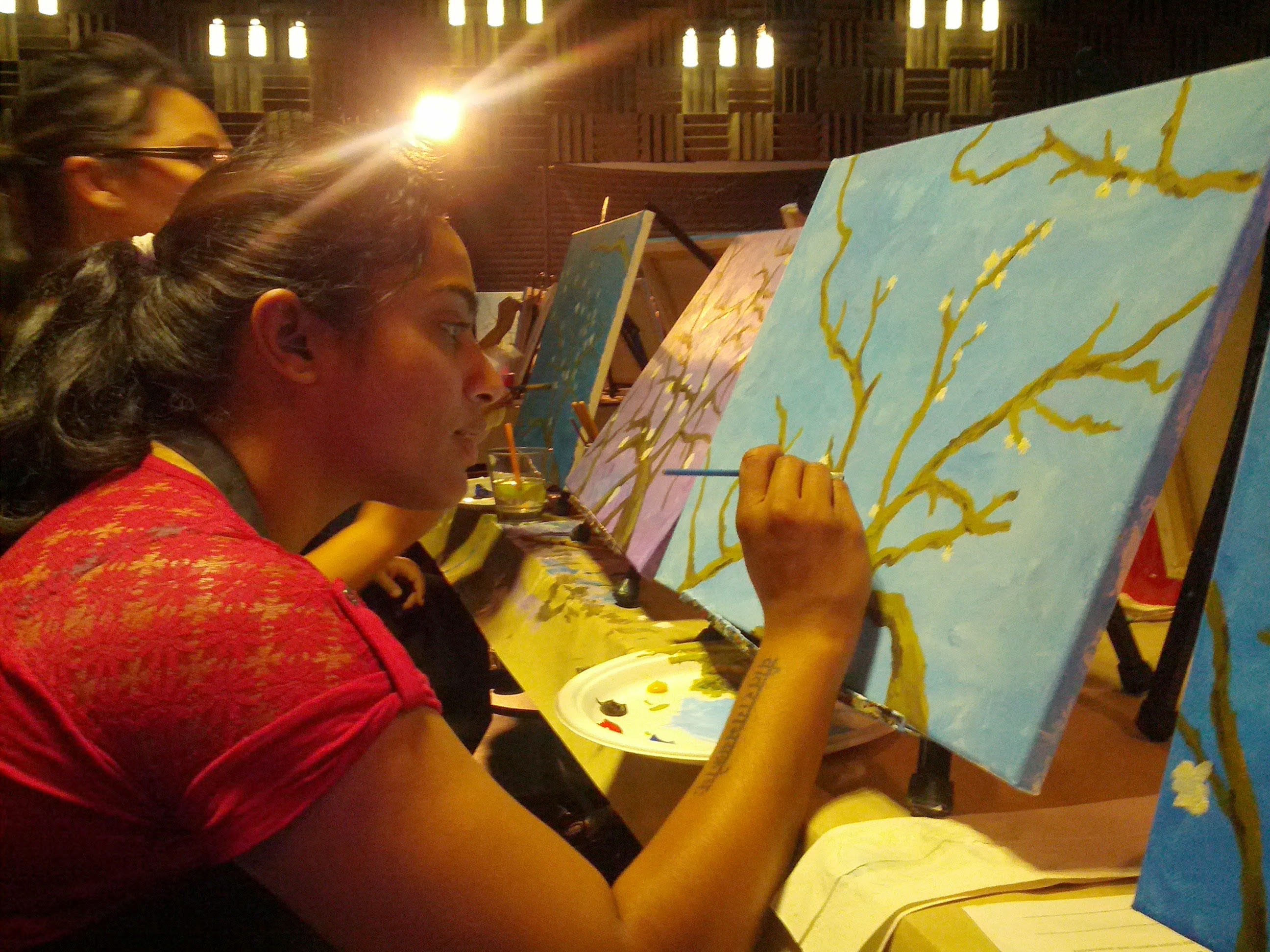
Treating your first draft as acrylic is extremely liberating. It’s not your final product. You’re just playing with goop. You don’t need clean lines and precision. Once you get the general shape of things, you’ll do it “for reals.”
Sometimes, I read over a scene I wrote previously and think, Wow that’s bad. Everyone’s grinning and smiling and nodding like they’re bobblehead dolls. You know what I do when I notice that? NOTHING. I just put a “TODO: clean this up” in the margins and move on.
Don’t count the salt crystals. You’re not an elf.
In the writing of a first draft, it’s easy to get distracted by certain tasks that are the equivalent of counting scattered grains of salt. You feel you must count all the grains of salt before you can proceed.
Examples of salt counting:
Not having the perfect name for your gorgeous new hottie character
Needing to get the dates and times right for a complicated plot sequence
Determining all the nuances of the magic systems / cursed techniques of your world
Needing to understand the details of the California criminal justice system for your one court scene
Ignore the scattered salt, and just keep cooking.
The first draft isn’t just an acrylic painting, it’s acrylic AND impressionist.
You don’t need to write the story in chronological order. You really don’t. You also don’t need to write the story from beginning to end. You can write whatever scene takes your fancy that day. You can write from whichever POV is speaking to you. It’ll all come together eventually, like the dots in an impressionist painting. For one of my books, I started writing in first person, then switched to third person. For another, I started in third, and switched to first halfway through. Can it be fixed later? If yes, proceed. Experiment away!
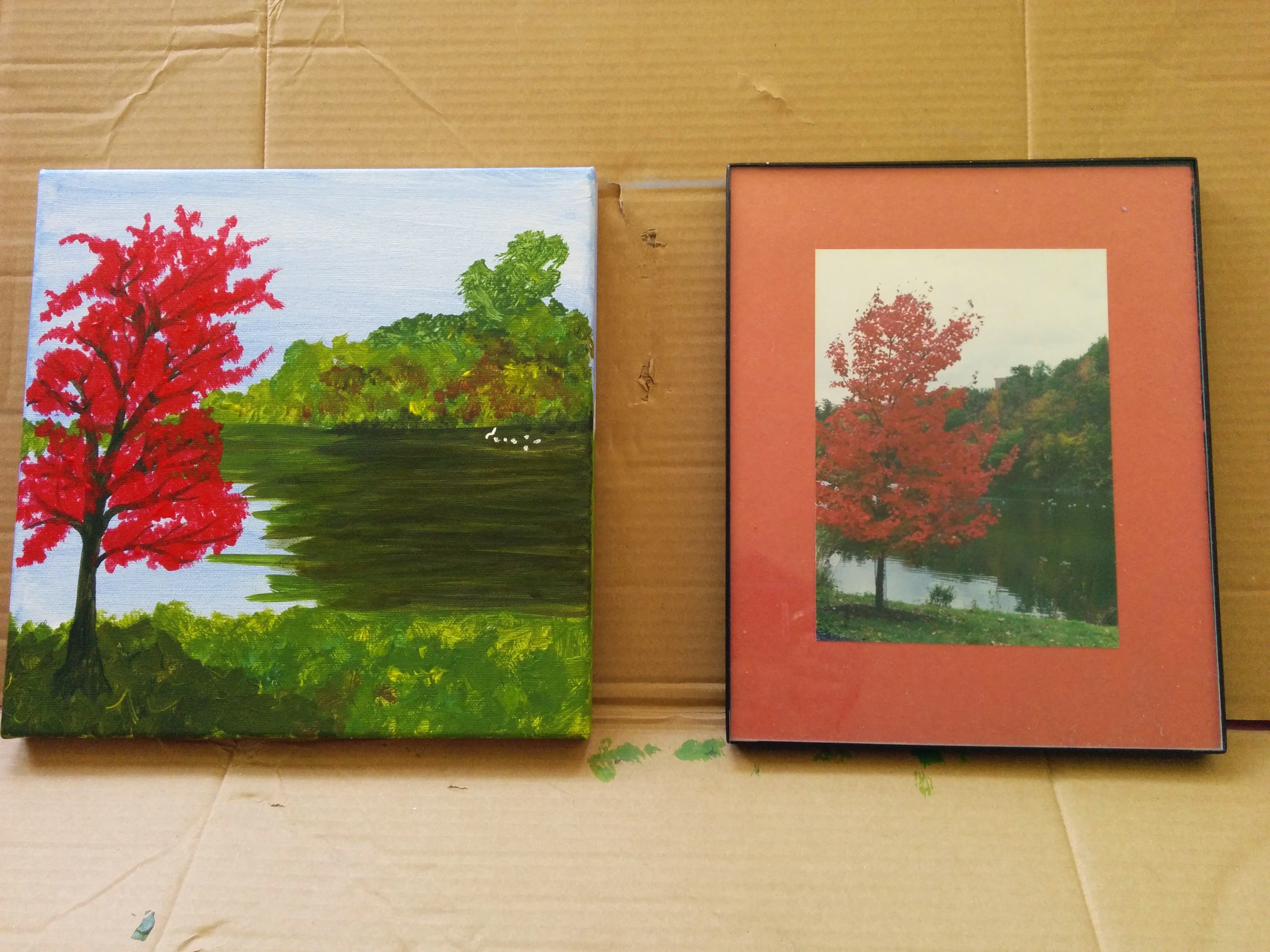
Don’t waste so much energy in the warm-up that you have none left for the game.
The first draft is just that. A First. DRAFT. By definition, it’s not the final thing. It’s not even the second thing. If you drag on with your first draft for months and years, you’re sucking on energy reserves you need for feedback and revisions. By the time Driving by Starlight got to publication, you could have told me there was a glaring typo on Page 2 and I’d have said fuck it, we’re shipping it anyway. I was so tired of the book, of reading, re-reading, revising, reading it aloud, editing, re-reading, rewriting, reading it aloud yet again, and then going through the publisher’s editing process.
I want to be excited at the prospect of revising, once I know what’s working or not working, not exhausted and traumatized. The first draft is so you can get your head in the game, that’s all.
Don’t stop. Try not to look back.
Write through to the end, as fast as you can. There will be plot holes. There will be poorly written scenes, or just placeholders that say {{TODO: figure out how fast you’ll bleed out if you’re stabbed in the head}}. But it’s important to get the beginning, middle and end of a story written down, to see the shape of the whole before you go tinkering with its parts. Pausing to admire or critique the beginning is a great recipe to either lose conviction in the story, or to hold yourself to an unreasonable bar where you can’t write the rest of the novel to the same quality as the opening pages.
Know your Story Why.
Your Story Why is why you’re bothering to write this story. It’s a catechism, a little prayer, something that reminds you why telling this story matters, even if nobody ever reads it. I had to write both Driving by Starlight and Her Golden Coast, to honor the little girl and the young woman I once was, trapped first by an oppressive society and then by a heteronormative, patriarchal one. I have a short (< 1000 word) essay for each story that explains why it felt necessary to write. This sort of thing usually gets incorporated into an Afterword or Acknowledgements – but writing it first is a powerful motivational tool. If I take a break from my story, reading the Story Why brings me back.
Welcome the prodigal home without complaint.
It’s not always possible to write every day, no matter how disciplined you try to be. So, rather than forcing myself into a habit I’ll only feel guilty about breaking, I focus on coaxing my inspiration back into gear. I think of my creativity as a friend I’d like to have over more often, but they’re super busy. So getting mad at them for the days they don’t come home is only going to ruin my mood on the days they do. So I keep a folder of things that can inspire me, to invite that friend in. If I read a really good story, or listen to a piece of music that is connected to the story, or have some great art that makes me want to write after I’ve taken a break, all the better.
Okay, so if I have all these nifty tricks, why did my latest novel (hereafter BWKB) take 9 months to birth a first draft? Depending on whether you only count published novels or unpublished ones too, BWKB is either my fourth or my eighth. At this point, I ought to have zero problems getting to my first draft. So what happened?
Two POV characters, both in first person, with very different voices.
Character A: We have scripts we follow, to remind people they’re not alone, not helpless, that we care about them; to thank them for being brave, for speaking up; to be compassionate, to not judge them for those thoughts but not egg them on either. To help them slowly create meaning as a sort of life-raft in the ocean, something to live for. We can live without a lot of things, but not without meaning.
Character B: Jail or Europe. Those were my choices when Mom found my stash of weed. If I graduated high school this time, Europe. If I failed again, jail. At eighteen, it wouldn’t be juvie.
Two timelines, twenty years apart.
I spent a lot of time trying to figure out what order to tell the story in, which events to reveal when, how to intersperse Now vs. Then, and then realized too late I was counting salt. Then I just wrote down the story and decided I’d splice the timelines later.
Genre? I never knew her
Technically, this latest novel is a psychological thriller. I’ve never written in this genre before, so I took a class (one I highly recommend). But it also meant I slowed down my writing pace to incorporate what I learned.
You can’t fake an apocalypse, but you can timebox it.
From the Greek apokaluptein ‘uncover, reveal’, from apo- ‘un-’ + kaluptein ‘to cover’. A psychological thriller relies on a lifting of veils, until the protagonist(s) see things they were (usually willfully) blind to. The big reveal in a psychological thriller has to hit at the core of someone’s identity, collapsing their belief system or sense of self. You can’t half-ass that with some combo of gaping + knees buckling + screaming incoherently. That cheats the reader. You have to make the experience of the apocalypse specific to the person suffering the revelation.
Which meant I needed to go through it myself, and I didn’t wanna. Except, as my Story Why reminded me, getting to that reveal, uncovering truths I’d hidden even from myself, was the whole point of writing the book.
It took a while to create the conditions for a contained apocalypse. A vacation to reset my mind, a weekend or two of isolation to take myself back to my teenage years, and a massage and plenty of chocolate to reward myself on the other side.
So, in some sense, it’s perfect timing for the completion of this first draft, here on a Saturday night, with Sunday left to decompress, rest my aching wrists, and be very, very thankful I’m not a teenager anymore. *shudder*
Let me know what you think, and share this post with others if it’s helpful!
I needed this post. I'm terrible at first drafts. It takes me FOREVER. I want to go back and revise so bad it hurts.
Jesus you can paint too??? Not to mention how fast you draft. In case anybody hasn't said it lately: you are a FORCE 💜