Keeping the Mirror Fair

We don’t live in a fair universe. Neither of my career choices, tech or writing, guarantees success as a consequence of competence and effort. Every writer experiences professional jealousy at some point or another, especially when someone whose writing “isn’t that good” achieves wild popularity or success. In the face of that, it’s very tempting to believe in a narrative of “I’m great, but the system won’t let me succeed.”
The Divine Comedy of the Tech Sisterhood is about a competent protagonist struggling against a system designed to crush women’s aspirations. I won’t give away the ending, but I will say that the narrative of “I’m great, but the system won’t let me succeed” is at once vindicating and limiting. Vindicating, because so many women have self-confidence issues, so recognizing the structural challenges keeping them from advancing is a HUGE step forward. But it’s also limiting, because many people stop there – Why am I not successful? Oh, the system is broken – instead of considering how they might break free anyway.
Each of my novels explores aspects of being helpless in a system, leaning on my experiences of having to hold onto my beliefs, my freedom or my sense of self-worth in the face of religious police, a brutal tech industry, or organizational and world politics.
Someone recently asked me how I’m able to tell when I’m right and the world is wrong from when I’m wrong and the world is right. In other words, in the diagram below, how do you tell if you’re in a light square or a dark square?
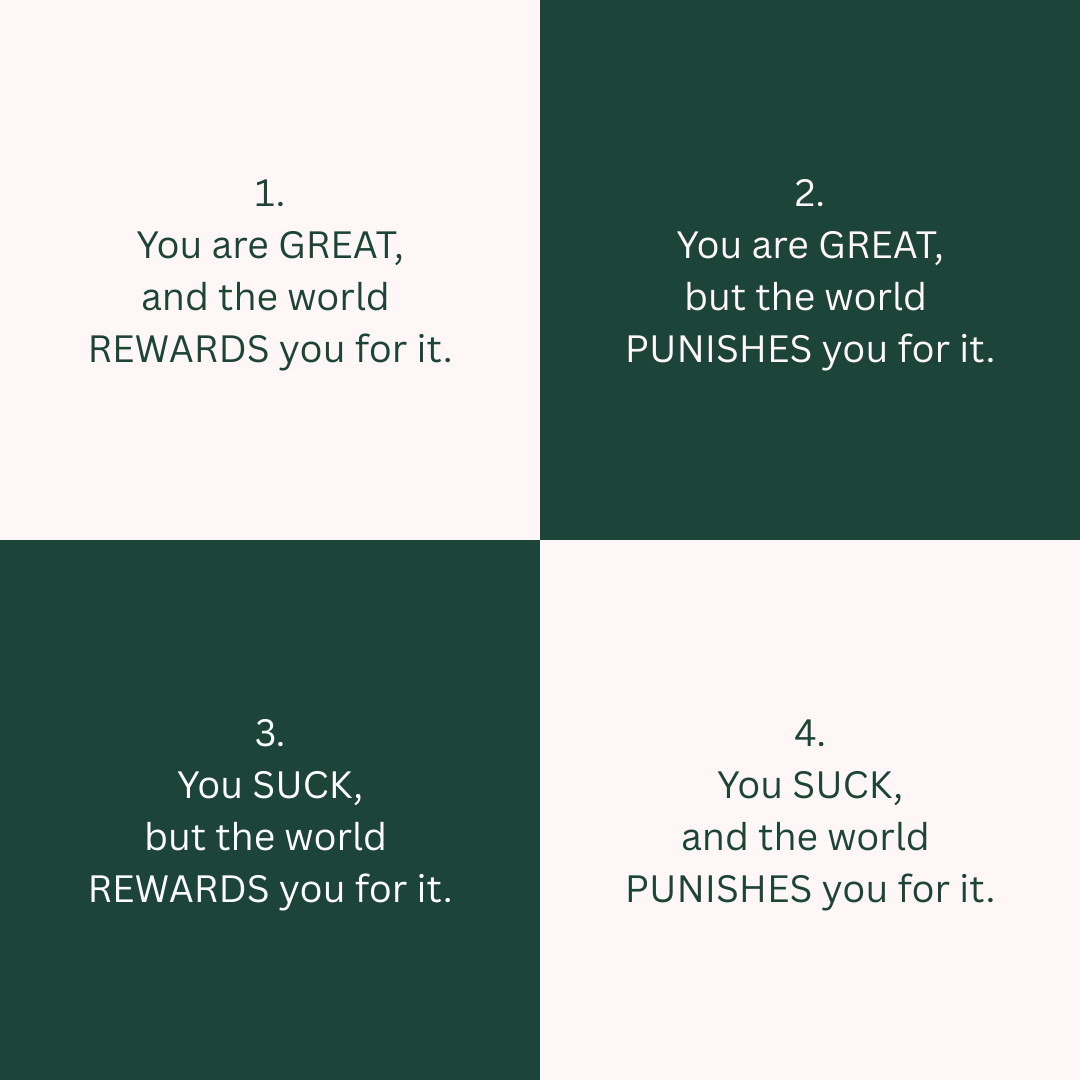
We want to believe only in the light pink diagonal, where the world is fair, and mirrors our own self-conception. But how are we to have a fair assessment of ourselves when the world’s mirror is how we develop self-conception in the first place?
Let’s make it concrete. Many people (especially those marginalized by society for some reason) have internalized a narrative of “I suck at Math / STEM / writing so I’ll never be successful.” They start out in Box 4, believing that they aren’t very good at what they do, and expect the world to mirror that back to them, which it usually does. Every time they encounter a setback, it reminds them that they are in Box 4 and will always stay there.
What could possibly pull them out of it? If they’re told “Actually, you’re good at X,” they wouldn’t believe it. They believe any rewards they earn are undeserved, and that they’re imposters who will one day be found out and punished. Usually, what pulls them out of it is discovering the existence of Box 3. “If that joker can get promoted / published, why can’t I?” Seeing someone who either is at your level succeed, or was at your level but got better, can motivate you… if you let it.
Gojo in Jujutsu Kaisen: The only thing holding you back is your mindset. You can only piece together undervalued data about yourself and others. You can’t imagine a stronger future version for yourself.
What keeps us from breaking out of Box 4? The simple answer: shame. We’d be ashamed to be in Box 3, to be hyped up and rewarded when we don’t think we deserve it. There’s no joy in being gifted a victory we didn’t earn. And let’s face it, we’ve all encountered arrogant assholes who think they’re so much smarter or better than we are, without the skills to back up their diva attitude.
When someone without the skills ends up reaping the rewards, we call that good luck. When someone who has the skills doesn’t get the rewards, we call that bad luck. Both types of luck take us to a dark green box, which makes us very uncomfortable with the universe. We’d rather stay in Box 4 and shit on ourselves than grant luck so much control.
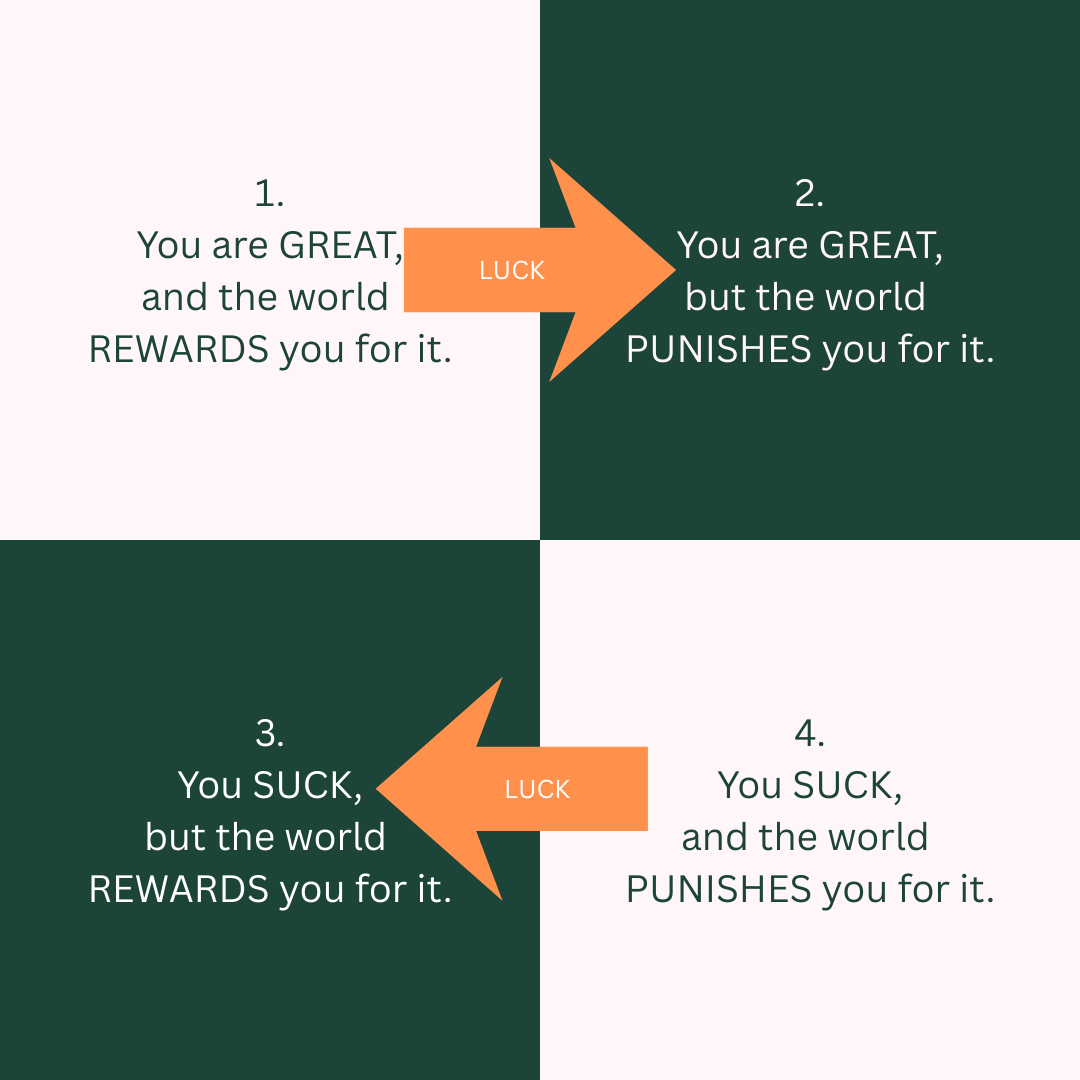
But Box 4 doesn’t interest me much, probably because I lack empathy. My interest is in Boxes 1 and 2. Getting to GREAT is entirely within your control, if you want it badly enough. The whole principle behind the shonen genre is that hard work and friendships result in victory. The development of self-esteem and confidence through constant improvement interests me. But it’s only possible if you’re able to separate your own understanding of your capabilities from the various mirrors the world might hold up against you.
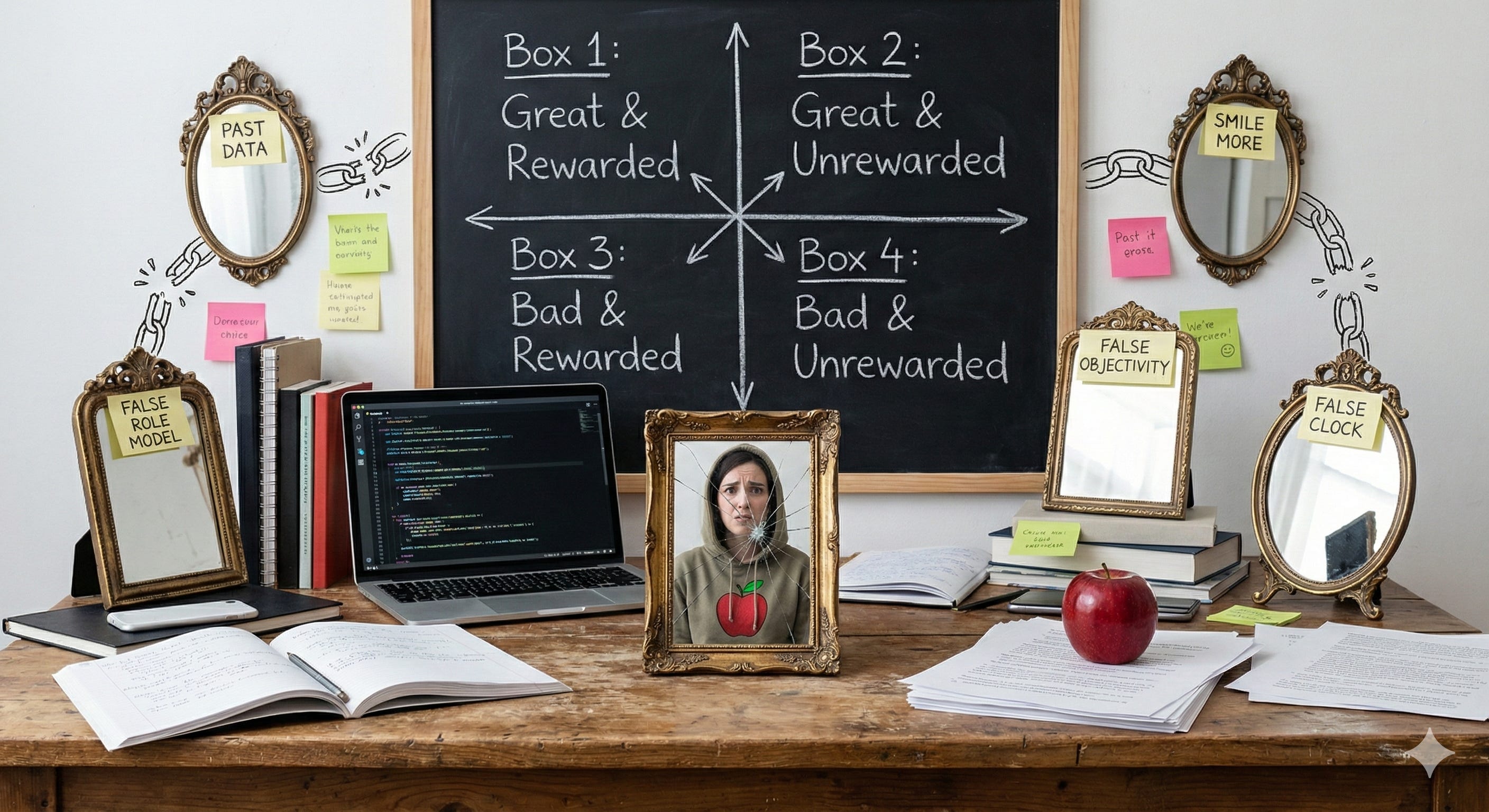
Mirror 1: Past Data
Mirror’s Judgement: You’ve never been able to do this before, so you’re not going to be able to do it in the future.
Refuting the mirror: The past is not actually a predictor of the future. Philosophy students know from studying David Hume that cause and effect exist only in the human mind. Inductive reasoning is not a property of the world. Or, as Wikipedia puts it:
Hume argued that inductive reasoning and belief in causality cannot be justified rationally; instead, they result from custom and mental habit. People never actually perceive that one event causes another but only experience the “constant conjunction“ of events. This problem of induction means that to draw any causal inferences from past experience, it is necessary to presuppose that the future will resemble the past; this metaphysical presupposition cannot itself be grounded in prior experience.
In lay terms, tomorrow is another day, and you might be a whole other person then, so don’t let the past limit you.
Mirror 2: The False Role Model
Mirror’s Judgement: If X, who’s so incredible and awesome, can’t make it, you never will.
Refuting the mirror: Using someone you admire to limit yourself is a perfect way to stay complacent and stunt your own growth. It’s also a great way to let the system win, by assuming that someone else’s ceiling has to be yours. When I first joined the tech industry, there were maybe one or two women in leadership. If I’d let that mean I couldn’t dream bigger than they did, I wouldn’t be where I am today. Moreover, I fully expect the next generation to surpass us, to do the things we couldn’t imagine for ourselves, just as I’ve done things my mother’s generation couldn’t dream of.
Mirror 3: Smile More
Mirror’s Judgement: If you really go after what you want, you’ll be shunned as selfish, abrasive, bossy…
Refuting the mirror: If you can’t defend against this mirror, you’ll never break out of Box 2. Fear of displeasing society becomes a self-fulfilling prophecy. You’ve already decided that society’s standards are how you’re going to let yourself get judged, and society is very happy to oblige you with that judgement.
Since I’m on Jujutsu Kaisen kick, here’s a short clip of the Girl of Steel deciding this mirror is nonsense.
Mirror 4: False Objectivity
Mirror’s Judgement: This {{neutral authority / official prize / publishing house / committee}} has decided you don’t meet their criteria.
Refuting the mirror: Philosophy, neuroscience and even forensic science refute the idea of objectivity, or a view from nowhere, free of bias. People who desire power will frame their ideas as truths. They must assert the authority of their committee and perspective in order to impose it upon the world. (If you’re interested in a deeper dive, this PDF essay is actually pretty good).
The only way to battle this mirror’s pronouncements is to know for yourself the criteria you’re trying to meet. If you tie your self-worth to achieving a certain level at work, or getting published, or selling X copies of your book, you’re giving the Mirror of False Objectivity power over you.
Mirror 5: The False Clock
Mirror’s Judgement: It’s too late for you; if you actually wanted to achieve your goal, you should have started 15 years ago.
Refuting the mirror: It’s a pretty quick Google search to find examples of people who started pursuing their dreams late in life. Writers who didn’t start until their 40s, and didn’t get published until their 60s. Lee Child famously started during his mid-life crisis after getting laid off from his job. So why do we hold up a mirror to ourselves that shows us a bunch of kids?
A great way to fight a bad clock is to give yourself a good one. My clock is “a book a year” – writing one, not necessarily getting it published. I know it’s doable because I’ve done it before, so in some ways it’s not ambitious enough (See Mirror #1 about anchoring on past data). But that only tells me I can actually hold myself accountable, instead of beating myself up about not meeting unreasonable expectations and sinking down to that blasted Box 4. If I can write a book every year, I will get better at it. I might not be able to control if I’m in Box 1 or Box 2, but I’ll stay in the top half of the diagram.
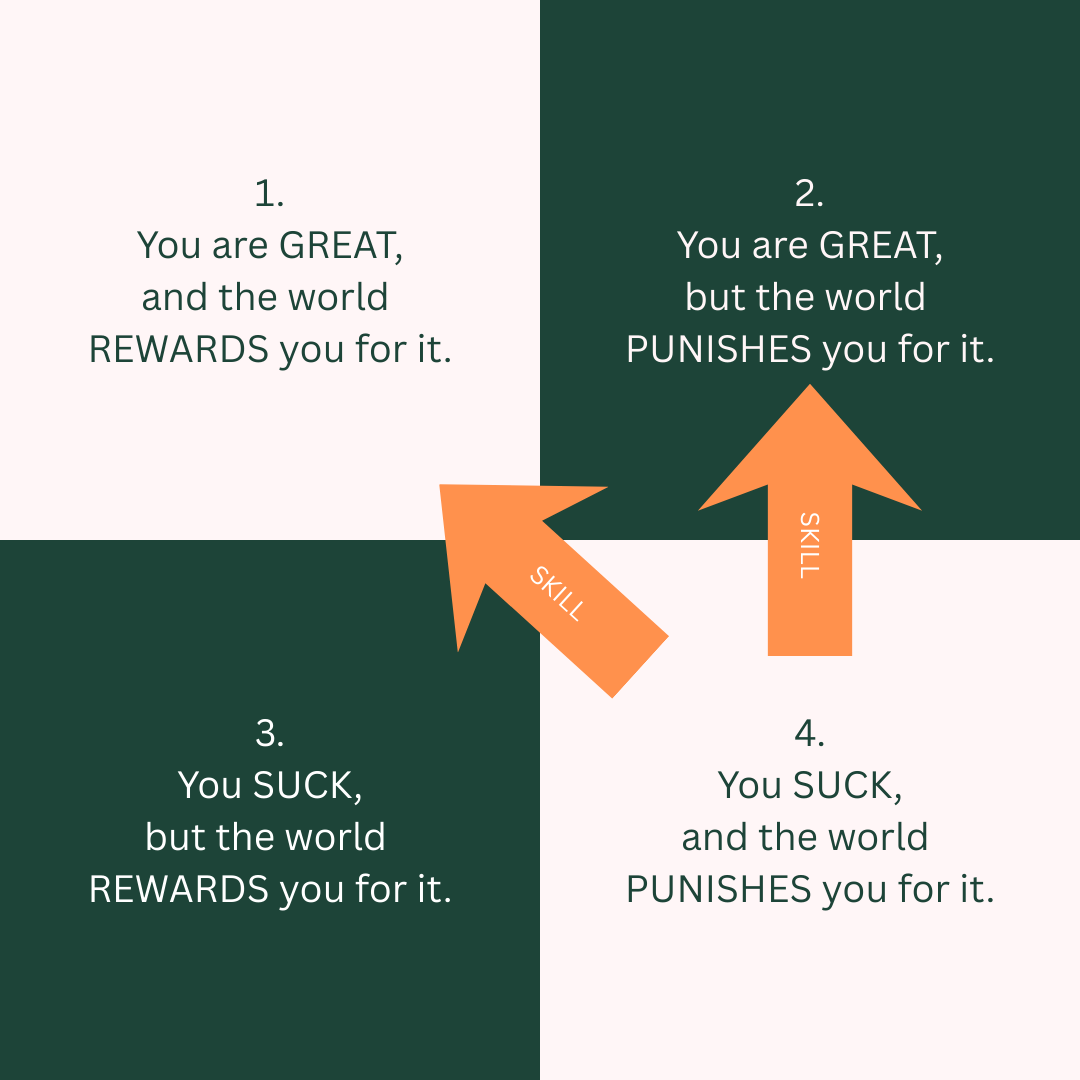
All this to say, keep writing. Getting better at a skill is its own reward, even in an unfair universe. I asked Gemini to generate an image for this post and it was… surprisingly good.