Give Me A Word

Other languages, particularly Japanese, have a lot of words for complex, nuanced emotions that make those of us writing in English feel like we’re painting with crayons. In an attempt to portray a few complex emotions I’ve been feeling recently, I invite all of you to suggest or create words for the following writer-life feelings:
1. Reading Taylor Jenkins Reid’s Atmosphere
I don’t want to like her books as much as I do. Ignoring the controversies around her politics, I find something unsettling about the way she writes women. Especially strong women. It’s so realistic. I’ve met these women. I hate these women. I don’t want to hate these women, or any women. Arguably, I’ve written a few similar women in my own books. But their relationship to power is fundamentally narcissistic. Cuban-American Evelyn Hugo passes as white to advance her acting career. In Atmosphere, Joan Goodwin is the people-pleasing “good teammate” who hides her sexuality to get NASA clearance. The more blatantly ambitious Lydia Danes acts like a man to succeed, but learns to team eventually from Saint Joan. Where are the women who are themselves with the reckless abandon of a shonen hero? Where are the women who refuse to compromise, who seek power not so they can be role models and break the ceiling themselves, but so they can burn down the world and build it anew?
Give me a word for the pleasure-rage of reading a writer you admire, who has an incredible gift for storytelling, matched only by a profound lack of imagination – even in fiction, she does not know how to make marginalized women – queer women, trans women, women of color – truly happy.
2. Following the drama around the Commonwealth prize stories accused of AI
The winners of the Commonwealth literary prize are being shadowed by claims that AI was used to create their work. The authors maintain they wrote it. The literary magazine Granta claims the winning story was ‘almost certainly not produced unaided by a human.’ If you think that’s a weird way of phrasing that they don’t know, don’t be surprised. That was the determination of the Claude AI that they ran the story through to ask if it had been produced by AI. BTW, this is what you call ironic, not rain on your wedding day.
Add to this drama some context. The winner is Jamir Nazir, from Trinidad and Tobago, a 61-year-old with “few publications to his name.” Could there be other reasons someone with that background has previously not seen success in mainstream publishing? Remember when the Latina Tiffany Martinez was told “hence” was not her word to use?
My professor assumed someone like me would never use language like that. As I stood in the front of the class while a professor challenged my intelligence I could just imagine them reading my paper in their home thinking could someone like her write something like this?
Give me a word for the judicial dread of not knowing whether someone of your skin-color is innocent and now being subjected to the most brutal, diminishing scrutiny; or guilty, and now every other writer of color is going to be suspected of not being entirely human.
3. Falling in love with Bungo Stray Dogs
I don’t watch TV. Rather, I watch the first 5 minutes of a show and then move on to the next, unless I get sucked in. When I do get sucked in, let it be known that I will watch the show, then read the book(s), then read all the fanfiction, and all the meta about the writer’s process, and then everything else they’ve ever done.
The pen-name of the writer of Bungo Stray Dogs is Kafka Asagiri. This is not a coincidence. Some of the key antagonists in the show are Francis Fitzgerald, Nathaniel Hawthorne, Lovecraft and Fyodor Dostoyevsky. Their superpowers in the show are based on their creative works, with Fitzgerald throwing money at problems and Hawthorne flinging the letter A that burns like a laser, and Fyodor musing about crime and punishment being very similar.
If I knew Japanese, I’d have figured it out right away, since Bungo apparently refers to “great writer” or “literary master.” Since I don’t, I had the shock-pleasure of watching this absurd drama unfold, then realizing that the writer’s name was Kafka, and then researching every other character in the show. The scene-stealing Osamu Dazai is based on a real writer of the same name whose real life was even more insane than that of a mafia executive who dreams of a double-suicide with a beautiful woman.
Give me a word for the liberation you feel as a creative person when you see someone else taking fearless creative leaps. While you’re agonizing over whether the tiny speculative twist in your fiction is credible, here’s someone who sees no issues with turning Edgar Allan Poe into a nerdy mystery writer in modern-day Yokohama.
4. Starting a novel over from scratch
I’ve done it a few times now. Written a novel all the way to the end, edited it and edited it, until I can no longer read the words on the page. I give it a few months, query agents, or send it to an editor for feedback, and then edit again. And then, suddenly, it hits me.
I need to start over.
Not copy over the pieces that work and make a collage. Not revise the POV or where to start telling the story. I mean, open a new Scrivener project, face a blank page, and tell the story all over, from the beginning, without looking at the previous version.
If you’ve done it yourself, you know the feeling. It’s not a “Why don’t I try it and see how the two versions compare?” It’s certainty. There’s something wrong, or missing, at the heart of the book, and you’ve got to start over from the beginning. Yes, you’ve put a lot into the old draft – time, money, possibly years of therapy and grief – but that was part of the process of turning you into the person you need to be to write the book right.
Each sentence you write sharpens your craft. The old versions are not sunk cost, they’re practice.
Give me a word for the feeling of stepping out onto a ledge, not because you want to, but because you must. It would be so much safer to stay in the comfort zone of what you’ve already written, and you don’t know whether what you do now will live up to that, and so you take each step forward in fear and trembling.
5. Having a writer you admire get your book
I’ve been working on a few different projects, but one of them is a standalone psychological thriller that’s simultaneously the easiest and hardest thing I’ve ever written. Easiest because of how much of it is autobiographical, and the material I needed (letters, emails, etc.) was already there. Hardest because of the level of emotional honesty required, even for a work of fiction.
I told the incredible Kia Abdullah (read her books!!!) the premise of my novel, and she wanted to read it even though it was only a draft. I wasn’t going to say no to having a professional thriller author give me feedback! And to have her say she “absolutely loved it” and that it was “unbelievably clever and gripping”?
Give me a word for that floaty, unreal feeling when the impossible happens, when you feel you could write or revise for days on end, because this world that only previously existed in your own head is now shared with someone else.
Snippets of Writer Life
Applications to the Journey to Jupiter writing retreat close June 1! I can’t recommend these people enough. They’re the real deal.
People have been asking me what the machine is that I’m hooked up to here. It sends an electrical current through your muscles as you work out, so you can get an hour’s worth of exercise in just 20 minutes. A colleague said, “So it’s like being massaged while you work out?”
“No,” I replied. “It’s like being tasered while you work out.”
Next week, I get to see Malala Yousufzai! There still seem to be a few tickets available for anyone in London.
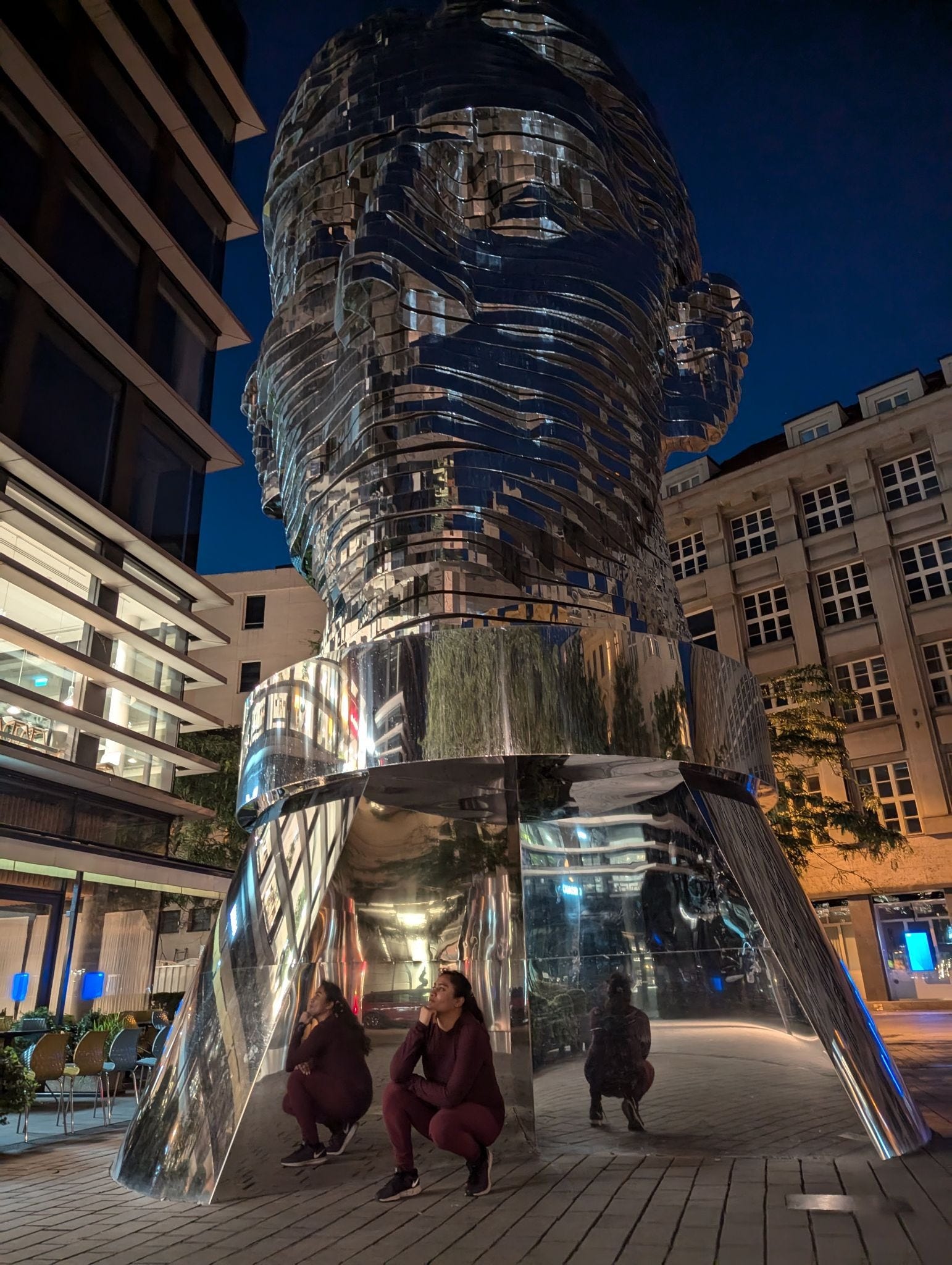
Below: me underneath Kafka’s head in Prague.
Heinlein is an author where I love half his works. He has two quirks to his writing, the first is his soap box moments where he has a character rant about something, which I can appreciate. The second is having the plot devolve into sex. For example Stanger in a Strange Land has a great first half but then devolves into a sex cult. I would use the word primadegenerace to describe the way some people make everything about baser emotions like sex or food or dominance.